How to remove bathroom mold without spreading spores
Bathroom mold spreads every time you scrub it dry. Here's the containment-first method we use in Palos Verdes Peninsula homes to kill mold without launching spores into the rest of the house.
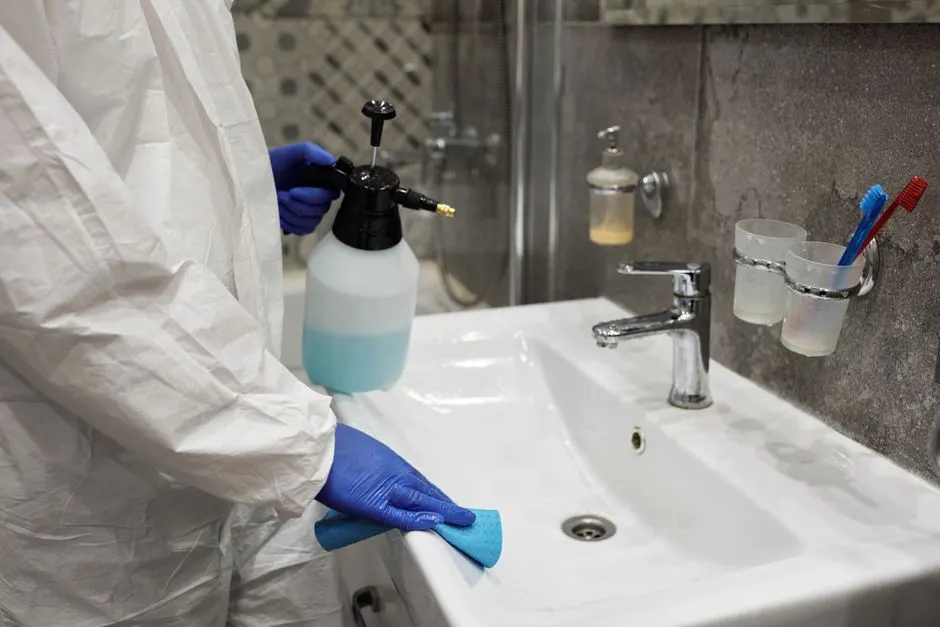
You remove bathroom mold without spreading spores by sealing the room, keeping every surface wet while you work, and bagging debris before it dries. Dry scrubbing is what launches spores into the air - wet contact is what keeps them on the sponge. The rest of this guide covers the exact containment steps, what actually kills mold on tile and grout, and when a Palos Verdes Peninsula bathroom has moved past what a homeowner should handle alone.
Why bathroom mold spreads so easily
Bathroom mold spreads so easily because every colony releases thousands of spores that go airborne the moment the surface dries or gets disturbed. A single square foot of active growth can hold millions of spores, and each one is roughly 2 to 10 microns wide - small enough to ride a draft through a doorway and land on the next damp surface.
Palos Verdes Peninsula makes this worse than most of Southern California. Marine layer humidity rolls in most mornings from spring through late fall, and homes here sit close to the coast where indoor relative humidity regularly climbs past 60 percent. Add a bathroom fan that vents into the attic instead of outside - common in houses built between 1950 and 1980 across the Hill - and you have a room that stays damp for hours after every shower.
Mold needs three things: moisture, organic food (drywall paper, grout, soap scum, wood framing), and time. Take away moisture and it goes dormant. Disturb it while it's dry and you get the opposite of what you wanted - a spore cloud that settles on curtains, towels, and the hallway carpet.
What you need before you touch anything
Before you touch anything, gather containment and PPE so you're not improvising mid-job. The supplies below cost $40 to $80 total at any hardware store, and they're the difference between a clean bathroom and a house-wide problem.
- N95 or P100 respirator - a dust mask is not enough. Spores pass straight through.
- Nitrile gloves and sealed eye protection - no vented safety glasses.
- 6-mil plastic sheeting and painter's tape - to seal the doorway and cover the vent.
- Two buckets - one for cleaning solution, one for rinse water. Never share.
- Microfiber cloths and a soft-bristle brush - no steel wool, no dry scrub pads.
- Heavy-duty trash bags (6-mil) - double-bag everything you pull out.
- HEPA vacuum - only if you own one. A standard shop vac will blow spores back into the room.
If you're not sure whether the growth is surface mold or something that has moved into the drywall, a Mold Inspection Near Me in PALOS VERDES PENINSULA, California gives you a straight answer before you start tearing anything open. We see this constantly in Palos Verdes Estates and Rolling Hills bathrooms where a slow toilet supply leak has been feeding the wall cavity for months behind intact tile.
How do I remove bathroom mold without spreading spores in Palos Verdes Peninsula, California?
You remove bathroom mold without spreading spores in Palos Verdes Peninsula, California, by containing the room first, then cleaning wet and bagging as you go. Here is the sequence our technicians follow, in order.
- Shut off the bathroom fan and HVAC. Air movement is your enemy. Tape the supply and return vents closed with plastic.
- Seal the doorway with 6-mil plastic and painter's tape. Leave a flap you can step through.
- Put on your respirator before you open the door. Not after.
- Mist the moldy surface with water from a spray bottle. You want it damp, not dripping. This is the single most important step - it weighs spores down so they can't launch.
- Wipe with a wet microfiber cloth, working from the outside of the patch toward the center. Fold the cloth to a clean side with each pass.
- Drop used cloths straight into a trash bag inside the containment. Do not carry them through the house.
- Apply your cleaning solution (see the next section), let it dwell 10 minutes, then wipe again with a fresh wet cloth.
- Rinse with clean water and dry the surface completely with a dedicated towel or a fan pointed at the wall.
- Double-bag all debris, tape the bag shut, and carry it outside through the nearest exterior door - not through the living room.
- Run a HEPA air scrubber or open a window for 30 minutes after you finish, then remove the plastic.
Expect a small patch - under 10 square feet on tile or grout - to take 45 to 90 minutes. Anything larger, or anything on drywall or ceiling, is a different job.
What kills bathroom mold and spores
What kills bathroom mold and spores is a cleaner that both destroys the organism and removes the surface it's feeding on. No product does both perfectly, so the honest answer is that you combine two.
What actually works
- Concrobium or a similar sodium-carbonate-based mold cleaner. It doesn't bleach the surface; it dries into a film that crushes spores as they try to grow. Best for grout, caulk lines, and painted surfaces.
- Distilled white vinegar (undiluted, 5% acidity). Kills roughly 82 percent of mold species on contact. Cheap, safe on most tile, but it won't remove staining.
- Hydrogen peroxide 3%. Kills mold and lightens the black staining on grout. Don't mix it with vinegar in the same bottle - they cancel each other out.
- Commercial bathroom mold removers with a registered EPA number. Read the label. If it doesn't have an EPA registration number, it isn't making a kill claim.
What people reach for and shouldn't
Bleach is the wrong tool for porous surfaces. It kills mold on contact with non-porous tile, but it cannot penetrate drywall paper, grout, or wood - so the roots survive and the colony returns within two to three weeks. Bleach also fumes in a sealed bathroom, which is exactly the room you've just closed off.
If you're dealing with a patch that keeps returning after two cleanings, that's not a cleaning problem - it's a moisture problem inside the wall. A Bathroom Mold Removal Service in PALOS VERDES PENINSULA, California will trace the source, cut out the affected material, and treat the cavity instead of the surface.
Common mistakes that make the problem worse
The mistakes that make bathroom mold worse are almost always about disturbing growth before it's wet or contained. These are the ones we see most often when we get called in after a failed DIY attempt.
- Dry scrubbing with a brush or sponge. This is the number one cause of cross-contamination. You're aerosolizing spores with every stroke.
- Running the bathroom exhaust fan while you clean. That fan pulls spores into the ductwork and, in older Palos Verdes homes, dumps them into the attic.
- Using a standard shop vac. Its exhaust is unfiltered. You're vacuuming mold up and blowing it across the room at the same time.
- Painting or caulking over mold. The mold eats through latex paint in weeks. You've just hidden the problem and given it a food source.
- Cleaning one spot and leaving the rest. Spores have already settled on the shower curtain, the bath mat, and the ceiling. If you don't address those, you'll be back in three weeks.
- Skipping the moisture source. If the ceiling above the shower is wet, no amount of surface cleaning will hold. That's a roof, attic, or plumbing issue.
For a ceiling patch that keeps returning, especially in single-story homes with attic ductwork, an Attic Mold Testing And Removal in PALOS VERDES PENINSULA, California often finds the real source - a bath fan venting straight into the insulation instead of through the roof.
How do I stop bathroom mold from coming back?
You stop bathroom mold from coming back by keeping indoor humidity under 50 percent and giving the room a way to dry out completely within 30 minutes of every shower. Cleaning is the easy part. Drying is the discipline.
- Run the exhaust fan for 20 minutes after every shower - not during, and not for 2 minutes. Set a timer if you have to.
- Verify the fan actually vents outside. Hold a tissue to the grille. If it doesn't pull tight, the fan is undersized or the duct is blocked.
- Squeegee the shower walls after each use. It takes 20 seconds and cuts surface moisture by roughly 70 percent.
- Leave the shower door or curtain open so air moves through.
- Fix drips within 48 hours. A slow toilet supply leak or a failing shower pan seal becomes a mold colony in about 72 hours at 70°F.
- Re-caulk grout lines and the tub surround every 3 to 5 years. Cracked caulk is where mold starts.
- Run a dehumidifier in coastal homes during the marine layer months - roughly May through October on the Peninsula.
If you've done all of that and mold still returns to the same corner, the moisture is inside the assembly. That's the point where DIY stops being cost-effective.
When to call a professional
Call a professional when the mold covers more than 10 square feet, when it's on drywall or ceiling, when you smell it but can't see it, or when anyone in the house has asthma or a compromised immune system. Those are the four triggers that move a job from cleaning to remediation.
There's also a practical limit. If you've cleaned the same patch twice and it's back within a month, you're treating a symptom. We handle that by finding the moisture source first, then removing the affected material, then verifying the fix with post-remediation testing. Our team at Mold Remediation Service works across the Peninsula and can usually tell you on the phone whether your situation is a cleaning job or a remediation job.
Typical 2026 pricing in this area runs $250 to $600 for a small bathroom surface treatment, $1,200 to $3,500 for a contained bathroom remediation with drywall removal, and $3,500 to $8,000 when the attic or crawl space is involved. Most single-bathroom jobs take one to two days.
Frequently Asked Questions
How do I remove bathroom mold without spreading spores in Palos Verdes Peninsula, California?
Seal the room with plastic, shut off the fan and HVAC, wear an N95 respirator, mist the mold with water before touching it, and wipe with a wet microfiber cloth. Bag debris inside the containment. Never dry-scrub. The whole process takes 45 to 90 minutes for a patch under 10 square feet.
What kills bathroom mold and spores in Palos Verdes Peninsula?
Sodium-carbonate cleaners like Concrobium, undiluted 5% white vinegar, and 3% hydrogen peroxide all kill mold and spores on contact. For grout and caulk lines, a sodium-carbonate cleaner leaves a residual film that prevents regrowth. Bleach kills surface mold but won't penetrate grout or drywall.
Should I use bleach on bathroom mold in Palos Verdes Peninsula, California?
No, not on porous surfaces. Bleach kills mold on tile and glass but can't reach roots inside grout, drywall paper, or wood, so the colony returns in two to three weeks. It also fumes heavily in a sealed bathroom. Use a sodium-carbonate mold cleaner or hydrogen peroxide instead.
How do I stop bathroom mold from coming back in Palos Verdes Peninsula?
Keep indoor humidity under 50 percent, run the exhaust fan for 20 minutes after every shower, verify the fan vents outside, squeegee walls after use, and fix any drip within 48 hours. Coastal Peninsula homes often need a dehumidifier from May through October.
When should I call a mold remediation service in Palos Verdes Peninsula, California?
Call when mold covers more than 10 square feet, appears on drywall or ceiling, returns within a month of cleaning, or when someone in the home has asthma. A pro will locate the moisture source, remove affected material, and verify with clearance testing. Most bathroom jobs take one to two days.
Get help with Mold Remediation Service in Palos Verdes Peninsula
If your bathroom mold keeps coming back, or the patch is bigger than a dinner plate, we'll come out, find the moisture source, and remove the growth without spreading it through your house. Call Mold Remediation Service Palos Verdes Peninsula at (833) 929-5837 and we'll tell you straight whether it's a cleaning job or a remediation job.